In short
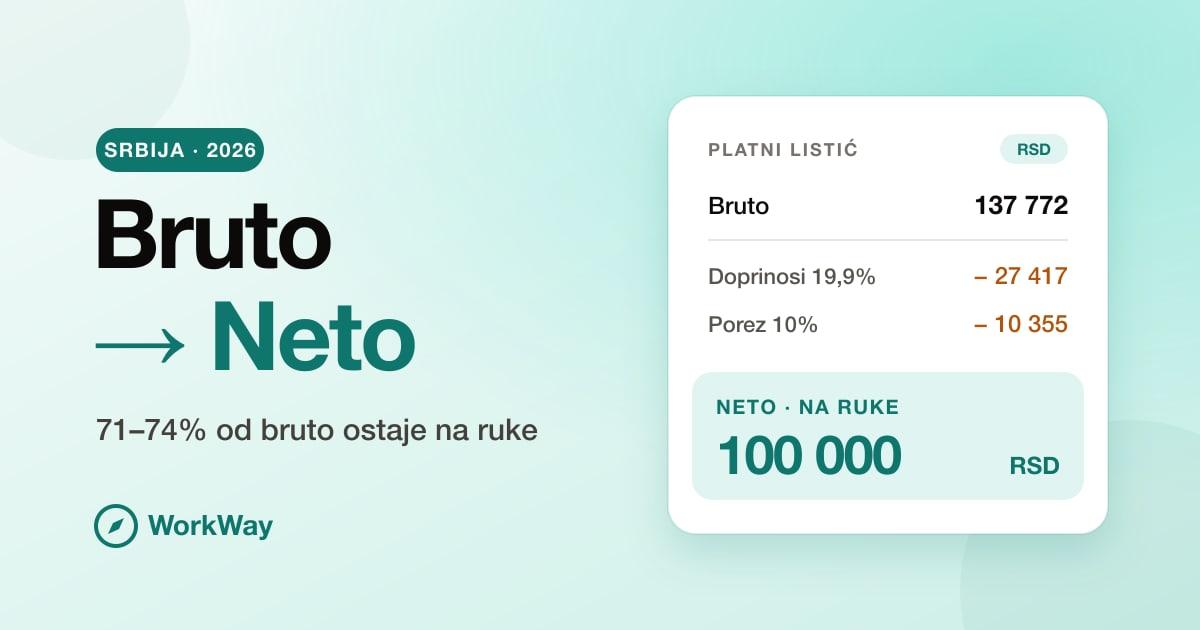
Net salary (neto) is the money that actually lands in your bank account. Gross salary (bruto 1) is the same pay before 10% income tax and 19.9% employee social contributions. In 2026 you take home roughly 71–74% of gross: the lower the salary, the higher the share, because the first RSD 34,221 a month is tax-free. When a Serbian employer says "plata 100 hiljada" (a salary of 100k), they almost always mean net.
Net, gross 1 and gross 2: what each one means
| Term | Serbian name | What it is |
|---|---|---|
| Net | neto zarada | The amount paid into your account |
| Gross 1 | bruto zarada | Net + income tax + employee contributions |
| Gross 2 | ukupni trošak zarade | Gross 1 + employer contributions — your total cost to the company |
Most confusion is between net and gross 1. Gross 2 matters if you hire people yourself or negotiate with a foreign company that budgets in total employment cost.
Which taxes and contributions are deducted in 2026
Your employer calculates and pays everything — you don't file anything yourself, except the annual tax return for high earners (see below).
| Deduction | Rate | Calculated on |
|---|---|---|
| Pension and disability insurance (PIO) | 14% | gross |
| Health insurance | 5.15% | gross |
| Unemployment insurance | 0.75% | gross |
| Total employee contributions | 19.9% | |
| Income tax | 10% | gross minus RSD 34,221 |
On top of that, the employer pays 15.15%: 10% pension and 5.15% health. You won't see it on your payslip, but it is part of gross 2.
Contributions are calculated on at least RSD 51,297 and at most RSD 732,820 a month (2026 limits). Above the upper limit, contributions stop growing.
How to calculate net from gross
- Contributions: gross × 19.9%
- Income tax: (gross − 34,221) × 10%
- Net = gross − contributions − tax
Example. Gross RSD 137,772:
- contributions: 137,772 × 0.199 = 27,417
- tax: (137,772 − 34,221) × 0.1 = 10,355
- net: 137,772 − 27,417 − 10,355 = RSD 100,000
How to calculate gross from net
If you know the take-home amount and need the gross figure (for a contract, a bank or your residence permit file):
gross = (net − 3,422.10) ÷ 0.701
3,422.10 is 10% of the tax-free RSD 34,221, and 0.701 is what remains after 10% tax and 19.9% contributions.
Conversion table: net → gross → employer cost (2026)
| Net (take-home), RSD | Gross 1, RSD | Employee contributions | Income tax | Gross 2 (total employer cost), RSD |
|---|---|---|---|---|
| 64,554 (minimum wage) | 87,207 | 17,354 | 5,299 | 100,419 |
| 80,000 | 109,241 | 21,739 | 7,502 | 125,791 |
| 100,000 | 137,772 | 27,417 | 10,355 | 158,644 |
| 117,282 (average, August 2026) | 162,425 | 32,323 | 12,820 | 187,032 |
| 150,000 | 209,098 | 41,611 | 17,488 | 240,777 |
| 200,000 | 280,425 | 55,805 | 24,620 | 322,909 |
| 300,000 | 423,078 | 84,193 | 38,886 | 487,175 |
Full-time employment, no tax relief, no sick leave. Rounded to the nearest dinar.
Minimum and average salary in Serbia
- Minimum wage 2026: RSD 371 net per hour, on average RSD 64,554 net a month (about RSD 87,207 gross). The exact monthly amount depends on the number of working hours.
- Average net salary according to the Statistical Office (RZS) for August 2026 was RSD 117,282; the median was RSD 93,325 — half of all employees take home less than 93k.
What changes on 1 January 2027
- The tax-free part of the salary rises from RSD 34,221 to RSD 37,369, so income tax gets slightly lower. For example, a net salary of 100,000 will correspond to a gross of 137,323 instead of 137,772.
- The minimum hourly wage becomes RSD 405 net — on average about RSD 70,470 a month (about RSD 95,197 gross).
- Contribution rates stay the same. The 2027 contribution limits are published in December; we will update the table then.
What to check when you get a job offer
- Ask directly: "Is that net or gross?" Local employers usually quote net; international companies and recruiters tend to quote gross — often as an annual figure in euros. Convert it to monthly net before comparing.
- Check the amount in your employment contract (ugovor o radu). The contract must state your base salary. If it is gross, use the formula above.
- The type of contract matters as much as the number. A regular employment contract gives you pension years, public health insurance and a basis for a residence and work permit. Working as a flat-rate sole trader (paušalac) follows different rules: you pay your own tax and contributions.
- Recently moved to Serbia? Ask about the Article 15v relief. An employer can reduce the tax and contribution base by 70% for five years for newly resident taxpayers whose salary is above the legal threshold. The saving goes to the employer, but it is a strong argument in salary negotiations.
- Annual tax for high earners. If your yearly income exceeds three average annual salaries (for 2025 income — above RSD 5,439,096), you file an annual return and pay 10–15% on the excess. Taxpayers under 40 get an additional deduction.
Sources
- Amendments to the Personal Income Tax Law — tax-free amount of RSD 37,369 from 2027 (National Assembly)parlament.gov.rs
- Government of Serbia: minimum wage of RSD 371 per hour from 1 January 2026srbija.gov.rs
- Paragraf: RSD 405 minimum hourly wage for 2027paragraf.rs
- Paragraf: RZS average and median salary for August 2026paragraf.rs
- Biznis.rs: 2026 minimum and maximum contribution basebiznis.rs
- Employee and employer contribution ratesunija.com
- Annual income tax: 2025 thresholdnovosti.rs
- Article 15v relief for newly resident taxpayerszuniclaw.com